−40−2002040 °C
✓Official 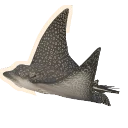
Ocellated Eagle Ray Habitat Requirements
Aetobatus ocellatus · Shark and ray · Base game
Habitat needs
Exported 2026-10-05Aquarium animals use tank space, not land area. The official data gives swimming space without a unit; compare values between species rather than reading them as square metres.
Terrain share
✓OfficialAllowed share of the habitat floor for each terrain type. The bar spans the minimum to maximum share.
- Sand 50%–100%
- Soil 0%–50%
- Rock 0%–20%
Group rules
✓Official- Preferred group
- 1–16
- Bachelor group
- 16 male / 16 female
- Mixed group
- 16 male / 16 female
- Temperament
- Confident
- Mating system
- Promiscuous
- Guest walkthrough
- Allowed
Breeding and lifespan
✓Official- Breeding difficulty
- Easy
- Gestation / incubation
- 1 yr
- Interbirth period
- 1 yr
- Sexual maturity
- 5 yr
- Litter size
- 1–3
- Juvenile
- 5 yr
- Adult
- 13 yr
- Elderly
- 12yr
- Food cost per period
- 478
Life stages and breeding times are given in years in the official data.
Compatible animals
Full matrix →From the official Zoopedia "Cohabitation Options" lists. A pair counts if either animal lists the other.
-
 Blackspotted Puffer✓ ThrivingListed as thriving in the official data, on the Ocellated Eagle Ray entry only.
 -
 Blacktip Reef Shark✓ ThrivingListed as thriving in the official data, on the Ocellated Eagle Ray entry only.
 -
 Clown Triggerfish✓ ThrivingListed as thriving in the official data, on the Ocellated Eagle Ray entry only.
 -
 Dolphinfish✓ ThrivingListed as thriving in the official data, on the Ocellated Eagle Ray entry only.
 -
 Giant Grouper✓ ThrivingListed as thriving in the official data, on the Ocellated Eagle Ray entry only.
 -
 Hawksbill Turtle✓ ThrivingListed as thriving in the official data, on the Ocellated Eagle Ray entry only.
 -
 Humphead Wrasse✓ ThrivingListed as thriving in the official data, on both entries.
 -
 Indo-Pacific Leopard Shark✓ ThrivingListed as thriving in the official data, on both entries.
 -
 Javanese Cownose Ray✓ ThrivingListed as thriving in the official data, on both entries.
 -
 Sailfin Snapper✓ ThrivingListed as thriving in the official data, on the Ocellated Eagle Ray entry only.
 -
 Sand Tiger Shark✓ ThrivingListed as thriving in the official data, on the Ocellated Eagle Ray entry only.
 -
 Red Lionfish~ NeutralListed as neutral in the official data, on both entries.
Enrichment items
✓OfficialEnrichment
- Submarine Buoy
- Bubble Blower - Airstone
- Lattice Ball
Food enrichment
- Forage Tray
Size, status and colour morphs
✓Official- IUCN status
- Endangered
- Size (leg span)
- 2.5 m
- Weight
- 1 kg
- Colour morphs
- Leucistic
Colour morphs
-
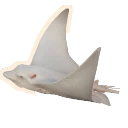 Leucistic
Official in-game portraits of the Ocellated Eagle Ray colour morphs.
How much area for N Ocellated Eagle Rays?
Area = minimum + (N − 1) × extra per animal. A planning estimate; the game decides the final check.
FAQ
What temperature does the Ocellated Eagle Ray need in Planet Zoo 2?
The official data gives a comfortable range of 24–27 °C for the Ocellated Eagle Ray. Keep the habitat inside that range and use the planner to compare it with other species.
How much space does the Ocellated Eagle Ray need?
According to the official data, the minimum is 180 deep swimming space (+45 each extra).
How many Ocellated Eagle Rays can live together?
The preferred group size in the official data is 1–16. Bachelor groups allow up to 16 males or 16 females, and a mixed group up to 16 males and 16 females.
What barrier does the Ocellated Eagle Ray need?
A Grade 2 barrier at least 1 m high.
Which animals can live with the Ocellated Eagle Ray?
The official Zoopedia lists 11 thriving cohabitants (Blackspotted Puffer, Blacktip Reef Shark, Clown Triggerfish, Dolphinfish, Giant Grouper, Hawksbill Turtle, Humphead Wrasse, Indo-Pacific Leopard Shark, Javanese Cownose Ray, Sailfin Snapper, Sand Tiger Shark) and 1 neutral cohabitant (Red Lionfish).
Data source: official Planet Zoo 2 Zoopedia export dated 2026-10-05. Text on this page is written by this site; the numbers are the official values.
More Estuarine animals
All Estuarine →Blacktip Reef Shark
Carcharhinus melanopterus
- Temp °C
- 22–28
- Group
- 1–10
- Barrier
- G2
Giant Grouper
Epinephelus lanceolatus
- Temp °C
- 24–29
- Group
- 1–5
- Barrier
- G2

Golden Trevally
Gnathanodon speciosus
- Temp °C
- 24–30
- Group
- 1–5
- Barrier
- —
Hawksbill Turtle
Eretmochelys imbricata
- Temp °C
- 22–30
- Group
- 1–4
- Barrier
- G2

Indian Ocean Oriental Sweetlips
Plectorhinchus vittatus
- Temp °C
- 24–28
- Group
- 1–5
- Barrier
- —
Indo-Pacific Leopard Shark
Stegostoma tigrinum
- Temp °C
- 24–29
- Group
- 1–20
- Barrier
- G2